

For those of you who’ve been reading regularly (Thanks! You’re the best!), you’ll probably remember how last week I shared the very dramatic, very stressful story of a deer launching itself into my rental car somewhere in the mountains between Tahoe and Yosemite. Since that was definitely the most cinematic failure I’ve experienced in a while, this week, I feel like moving toward the opposite end of the spectrum because I think the contrast is actually worth something.
This week’s failure has no injured wildlife, no sheriff, no murder-motel, and no kindly stranger named Eddie. This week’s failure is just a medical bill that I can’t figure out how to pay.
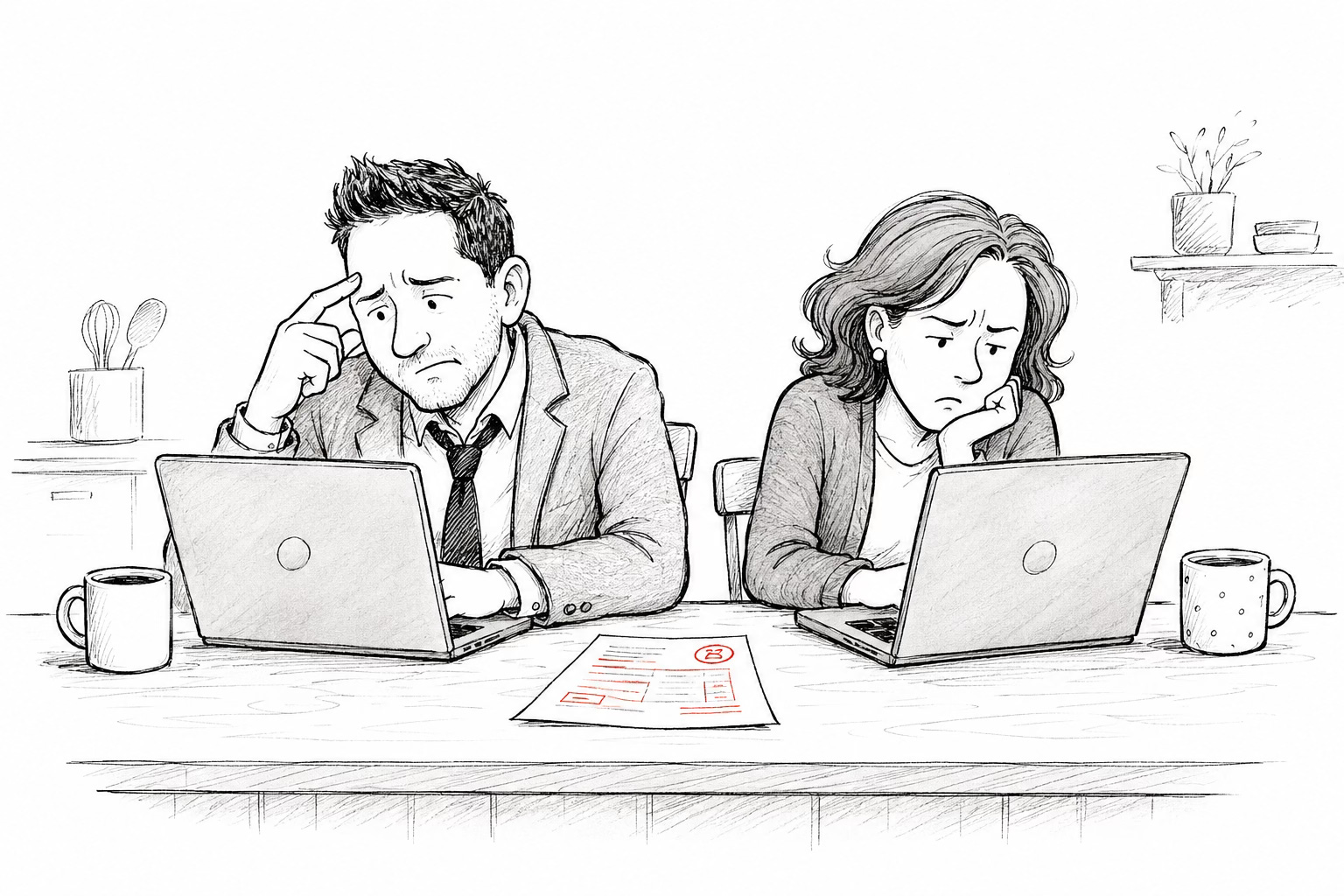
Here’s the situation. Apparently we owe a small co-pay for one of our daughters. Duke Health, my healthcare provider, called my wife about it, and, rather than reading her credit card number to a stranger on the phone who may or may not have actually been from Duke Health, did the very responsible thing and said she’d just hop online and pay it through the portal, the way she always has. So she logged in, navigated over to our daughter’s account, found the bill, went to pay it… and then discovered she’s no longer able to because she isn’t listed as the “guarantor” on the insurance.
I’m the guarantor. Our health insurance runs through my employment, which means I’m the one the system recognizes as financially responsible.
Fine. No problem. I’ll just log in and pay it myself. Except our daughters’ medical records are connected to my wife’s account, not mine. So my wife can see the bill but isn’t allowed to pay it. And I’m allowed to pay it, but I don’t have any way to see it. The bill exists in a kind of administrative purgatory, fully visible to the one person who can’t act on it and fully payable by the one person who can’t find it. As of this writing, it remains gloriously, stupidly unpaid. And it’s not because we’re unwilling or can’t afford it. It’s simply because the system has constructed a small, perfect maze with no exit.
Somebody, Somewhere, Ticked a Box
What I love about this failure — and I do, in a way, love it — is there’s no villain or evil mastermind. Nobody at Duke Health woke up one morning intending to make it impossible for me to give them money. Instead, what almost certainly happened is that somewhere an administrator or a software vendor or a committee made a perfectly reasonable-sounding decision. It just didn’t account for a weird edge-case they had no real reason to imagine.
And I’m sharing this story because it’s a great example of what failure actually is. It’s bureaucratic. It’s the accumulated downstream consequence of a thousand individually reasonable choices, made by people who couldn’t possibly have anticipated how their small decisions would interact with everyone else’s small decisions.
It’s the least dramatic failure imaginable. And yet, it has something important in common with the poor deer that collided with my rental car last week.
The Hidden Thing the Deer and the Bill Share
My family’s collision with that deer was random. There’s no lesson in it, or cause we could have addressed. An animal made a decision at a moment we couldn’t have predicted, and our day was upended. Pure circumstance.
The medical bill is also random. The particular collision of rules that’s trapped us isn’t aimed at us. We happened to be the family whose arrangement of employment, insurance, and parental record-keeping fell into a weird crack in the policy. One different decision a decade ago, and the bill gets paid in thirty seconds. We didn’t earn this failure any more than we earned the deer.
More importantly, this extends way beyond deer and medical bills. Most failures are like this. Even the ones that look causal — the ones that seem to clearly imply you did something wrong — are filled with chance and randomness.
For example, maybe you gave a presentation last week, your boss tore into it, and you spent the rest of the day convinced your work was bad. But what if your boss stubbed his toe on the way into the room, or got a worrying text from his doctor, or simply didn’t sleep well. Maybe the thing you’ve been carrying as evidence of your own inadequacy was, in reality, a stubbed toe you never saw. You’ll never know, and that uncertainty is precisely the point.
We have a deep habit of reading our failures as judgments on our competence, our worth, our intelligence, and our ability. But a failure is rarely a verdict. It’s just data generated by a tangle of circumstances, most of which had nothing to do with you.
The deer wasn’t a referendum on my driving. The bill isn’t a referendum on my responsibility as a parent. And your bad meeting was, quite possibly, a referendum on someone else’s toe.
Failure isn’t a grade the universe assigns you. It’s information about what happened — circumstance, chance, and sometimes just bureaucracy, all of which look an awful lot like judgment until you remember to ask: What else was going on, and how much of it was completely beyond your control?
By the way, the bill is still unpaid. If anyone at Duke Health is reading this, I’d genuinely love to give you your money. I’m just not bureaucratically permitted to unless you’d like to help.
In the Moment…
A helpful reframing for those moments where failure feels possible.
When something goes wrong and you feel that familiar pull to read it as a verdict on your competence, your worth, your judgment, etc., I want you to pause. The story you tell yourself in the first few minutes after something happens is usually the least accurate one you’ll ever have access to, but, unfortunately, the most powerful one. So try asking some of the following questions in order to disrupt it:
How much of what just happened was actually within my control, and how much was circumstance I’ll never fully see?
What else might have been going on for the other people in this situation that I’d have no way of knowing about?
Am I treating this as information about what happened, or as a judgment about who I am?
If a friend described this exact situation to me, would I read it as their failure, or as bad luck?
What’s the most boring, least dramatic explanation for this, and is it possibly the true one?
To be clear, the goal with these questions isn’t to dodge responsibility for the failures that are genuinely yours. Instead, the goal is to stop automatically assigning yourself the full blame for results that had plenty of other inputs.
The Debrief…
Reflecting on our experiences is where the most important learning happens.
After some time has passed and the sting of whatever failure you experienced has faded, it’s worth going back and separating what you actually controlled from what you merely absorbed. That separation is where the real learning hides. Try asking:
Looking back, what part of this was genuinely mine to own, and what part was circumstance I happened to be standing in front of?
What judgment did I assign myself in the moment that, with distance, looks less deserved than it felt?
Where have I been carrying a past failure as evidence about myself when it was probably just chance?
If this was mostly circumstance, what’s the actual lesson?
What would change about how I move through the world if I genuinely believed most failure is data rather than a grade?
Again, our goal here isn’t to avoid responsibility for whatever bad thing happened. We just want to make sure you’re only feeling responsible for the parts that are actually yours.