
The First Inning
Failure #56 - The more you know, the more frustrated you'll get with people who don't know.

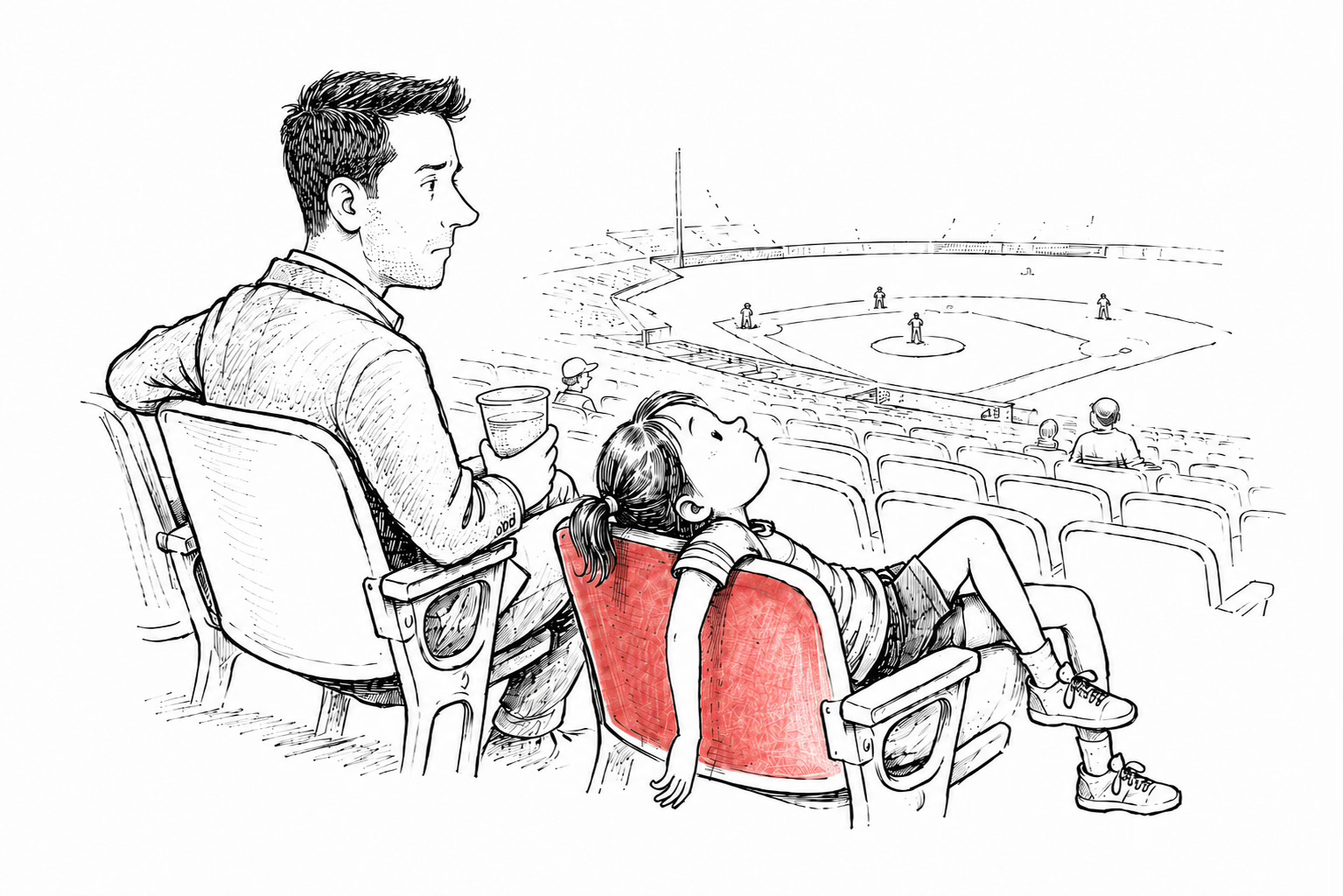
Last week, I took my family to a baseball game at our local minor league park. For the first couple of innings, my seven-year-old was perfectly content, mostly because she was eating snacks. By the third inning, she’d started fidgeting. By the fourth, she was draped over her seat, singing quietly to herself. And by the fifth, she’d entered a state of full existential despair, sighing up at the sky like a tiny philosopher confronting the fundamental meaninglessness of it all.
Naturally, I asked her what was wrong. Why wasn’t she having fun? Why didn’t she want to watch the game? And she gave me an answer that, in retrospect, should have been obvious, but somehow caught me completely off guard.
“I don’t understand what’s going on.”
The Thing I Couldn’t Explain
Of course she didn’t understand. She’s seven, and nobody had ever actually explained baseball to her. She was staring at a field where grown adults periodically threw a ball, swung a stick, and ran around in a seemingly random pattern while thousands of strangers cheered at moments that, to her, had no discernible logic. Why on earth would that be fun? It would be like being taken to a three-hour opera in a language you don’t speak and being asked to enjoy the plot.
Obviously I decided I would fix the problem by explaining the rules of baseball. Once I did, she’d understand the game, and then — in my imagination, at least — she’d fall in love with it and we’d have a lovely father-daughter evening.
I began to explain: “Okay, so there’s a team that’s hitting, and a team that’s fielding. The hitting team is trying to score runs by getting all the way around those four bases.” Fine so far. But then the rules started branching. “The fielding team is trying to get the hitting team out, which they can do by catching the ball in the air, or tagging the runner, or sometimes just by stepping on the base while holding the ball — except that only works in certain situations, depending on whether the runner’s forced to run, which depends on who else is already on base…” I watched her eyes glaze further with every added clause. There were balls and strikes and fouls and innings, each one requiring three more concepts just to explain the first, and about ninety seconds in, I realized I had no idea how to make any of this make sense to a person starting from zero.
And it wasn’t for lack of understanding on my part. I’ve understood baseball for as long as I can remember, which, it turns out, was exactly the problem. I don’t actually remember learning baseball. It simply seeped into me over an entire childhood of backyard catches and little league games and summer afternoons on the couch until it felt as natural and obvious as breathing. And so, sitting there next to my miserable kid, I discovered I had no way to hand her the thing she was missing because the thing she was missing was never something anyone handed to me.
Eventually, I gave up trying to explain the rules. My daughter wasn’t interested. She was busy being bored, I was getting frustrated, and we left in the seventh inning without her falling in love with baseball. In fact, as far as I can tell, she likes it exactly as much now as she did before, which is to say, not at all.
The Curse of Already Knowing
Psychologists actually have a name for part of what happened to me that night. They call it the “curse of knowledge.” It’s the cognitive bias where, once you understand something well, you lose the ability to remember what it felt like not to understand it.
Interestingly enough, it’s also one of the reasons experts often make terrible teachers. The thing they’re explaining feels so obvious that they skip the very steps beginners actually need.
But the more I’ve thought about that baseball game, the more convinced I’ve become that the curse of knowledge creates a second problem that’s even more damaging.
It doesn’t just make us bad at teaching. It makes us impatient with beginners.
Once we’ve forgotten how confusing something used to feel, we start treating confusion as evidence someone isn’t trying hard enough. We wonder why new employees ask “obvious” questions. We roll our eyes when a colleague struggles with software we’ve been using for years. Or we get frustrated when our kids don’t immediately grasp something that seems completely intuitive and leave in the middle of the seventh inning.
Simply put, the better we know something, the more we feel like learning should look smooth. You study, you understand, you move on. If you’re confused, you’re behind. If something feels difficult, you’re missing something everyone else already knows.
But that’s almost never how learning actually works. Real learning is awkward and full of half-formed explanations where every answer somehow creates three new questions. It’s sitting in the stands of a baseball game wondering why everyone around you seems to understand something that feels completely arbitrary.
And if we’re honest, adulthood feels like that far more often than we’d like to admit.
Starting a business feels like that.
Parenthood feels like that.
Leadership feels like that.
Marriage feels like that.
Every meaningful part of life eventually asks us to become beginners again.
Which means the real challenge isn’t learning baseball… or business, or parenting, or leadership. The real challenge is remembering what it felt like to sit in the stands, completely confused, while everyone else seemed to understand the game.
If we can hold onto that feeling — both for ourselves and for the people learning beside us — we’ll probably become better teachers, better leaders, and, perhaps most importantly, kinder and more patient human beings.
When You’re the One in the Stands…
The next time you find yourself lost while everyone around you seems fluent in something, here are some questions you might try asking yourself:
Is this confusion a sign I can’t do this, or just a sign I’m in the early innings of learning it?
Am I comparing my beginning to other people’s middle — measuring my first game against their hundredth?
Did the fluent people around me actually learn this instantly, or have they just forgotten how long it took?
What would change if I treated this awkward, half-formed stage as a normal part of learning rather than proof I don’t belong?
Am I about to walk out in the seventh inning of something that was always going to take longer than one game to understand?
Confusion isn’t evidence you’re failing. It’s usually just evidence you’ve started learning something complicated.
When You’re the One Who Already Knows…
Being an expert trying to help a beginner can be frustrating. And simply reminding ourselves to have patience isn’t usually as effective as we’d all like it to be. Instead, when you feel that flash of impatience with someone who “should” get it by now, try asking:
Do I actually remember what it was like to not understand this, or has that feeling become invisible due to my own expertise?
Is this person struggling because they aren’t trying, or because they’re simply earlier on a path I can’t remember?
What are the “obvious” steps I’m skipping because they stopped feeling like steps to me a long time ago?
Am I treating their confusion as a character flaw when it’s really just missing information?
The kindest thing you can do for a beginner is remember you were once one, too. Who was patient with you in those early moments of learning, and could you be more like them?