
Fail Watching
Failure #57 - The thing you’re looking for isn’t always in the direction you’re staring.

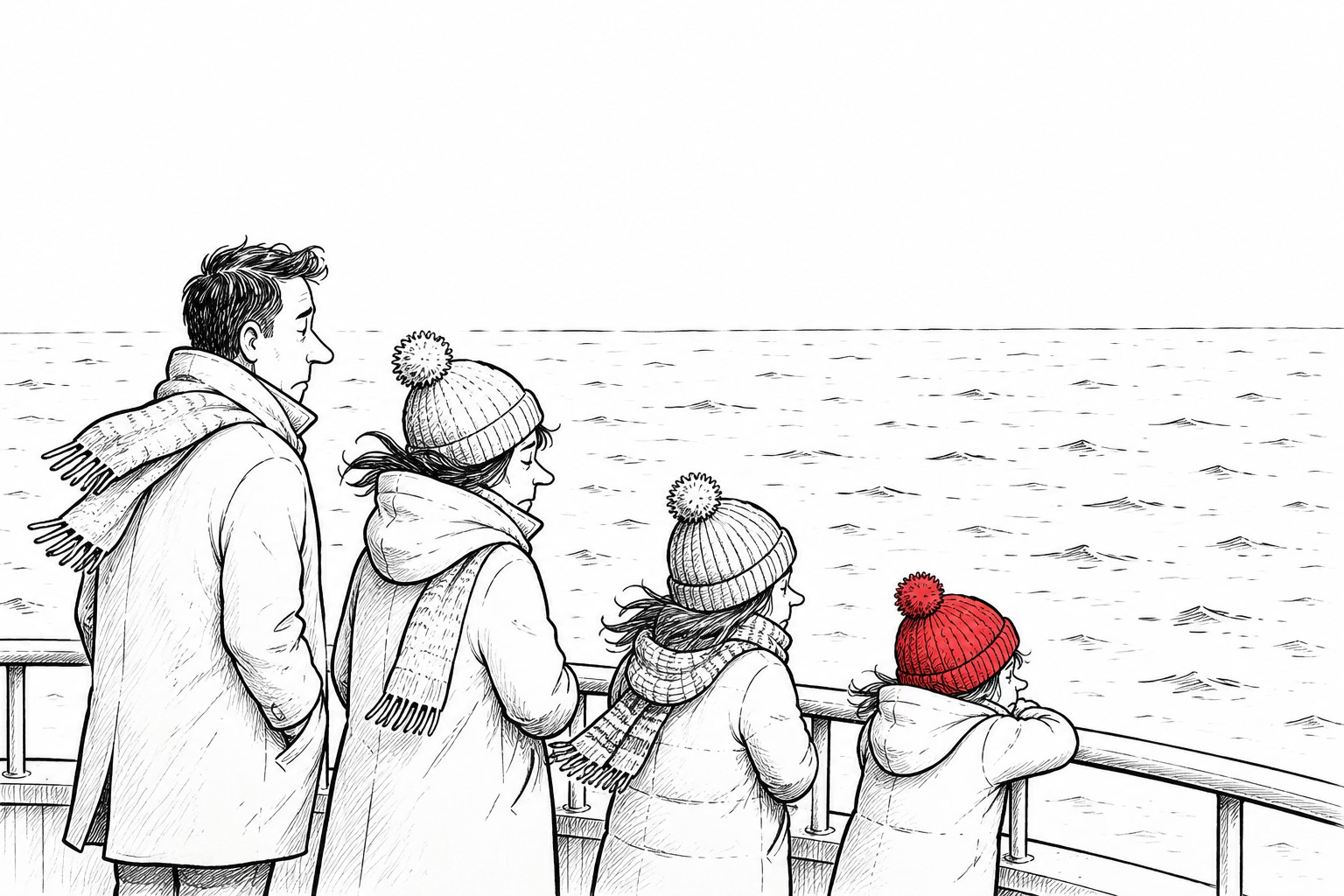
Last week my family and I were in Iceland. By chance, the trip overlapped with my birthday, which was a coincidence rather than a plan, but it meant I had some unusual choices for how to spend it. I ultimately settled on whale watching, mostly because, like eating beignets in New Orleans, whale watching in Iceland seems to be one of those things you’re contractually obligated to do.
Unfortunately, we didn’t see any whales.
However, we did get to see the North Atlantic in a decently foul mood. For two hours, we stood on the deck of a small boat as the wind worked its way through every layer we’d optimistically described as “warm enough.” My youngest lost feeling in her face somewhere around the forty-minute mark. I didn’t last much longer. And I’m still not sure I can feel all my fingers. By the time we finally shuffled back onto the dock, we looked less like a family on vacation and more like four windswept popsicles.
As we walked away from the boat, my oldest daughter said, “Well, that was a complete waste. Sorry we ruined your birthday.”
An Early Verdict
When I was her age, I would have said exactly the same sentence. Honestly, ten years ago I probably still would have. We went to see whales, and we didn’t see whales. As a result, the outing failed and the day was… not entirely ruined, but certainly diminished.
However, thanks to a decade of thinking and teaching about failure, I’m finally learning how to slow down my temptation to rush judgment, particularly when that judgment is negative. So instead of immediately agreeing with my daughter, like I might have not too long ago, I asked her why she thought we’d ruined my birthday.
“Because we didn’t see any whales,” she rightfully replied.
“Okay,” I said. “But think about what would happen if we had seen whales. We’d have been excited for about ten minutes. We’d have taken some blurry photos of a fin. And then, honestly? In two years none of us would remember it. It would just be one more nice thing that happened on a trip.”
She didn’t look convinced, which is fair, because she was still cold. So I kept going. “But this? This is something we’re going to talk about forever. Every single birthday from now on, somebody’s going to bring up whale watching. When you’re older and you bring someone you’re dating home for Thanksgiving, this is a story we’ll tell them. When you have kids of your own, they’re going to hear about that one birthday of Grandpa’s where the family nearly froze to death looking at an empty ocean. So is that a waste? Or did we just make something incredibly special?”
My daughter thought about it for a second and then chirped back, “That’s kind of annoying.” Which I’m choosing to interpret as agreement.
What We Were Actually Watching For
The excursion was sold to us as whale watching. But what we actually spent two hours doing was something closer to fail watching — standing on a deck together, scanning an empty sea, slowly and collectively realizing that the thing we came for wasn’t going to happen. But, oddly enough, that shared experience of not seeing whales is going to be much more valuable than seeing them could have ever been.
Successes have a way of getting consumed. You get the thing, you enjoy it, you file it away, and then it quickly dissolves into the general pleasantness of a life that went basically fine.
In contrast, failures get retold. They become stories, and stories are a form experiences take when they want to survive. Nobody at Thanksgiving has ever said, “Remember that vacation where everything went according to plan?” The stories that get passed around a table for thirty years are almost always about the flight that got cancelled, the wedding where something went horribly wrong, or the trip where absolutely nothing worked. The failures are what we’re still holding onto, long after the successes have evaporated.
Which means my daughter wasn’t wrong about the facts. She was wrong about the timing. She rendered her verdict — “complete waste” — at the precise moment she had the least possible information about what that experience would eventually be worth. She was grading the day using the only measure available on the dock, which was the one we’d brought with us: did we see whales? But, in the years to come, that’s not going to be the measure that matters.
To be fair, I should be careful here, because there’s a lazy version of this idea that I don’t believe at all. I’m not suggesting every failure secretly becomes a gift, or that things always work out, or that a bad day is really a good day wearing a disguise. Plenty of failures are just losses, and they stay losses, and no amount of retelling redeems them. So that’s not my argument.
The point I’m trying to make is smaller and, I think, more useful: you almost never know what an experience is worth at the moment you’re having it.
We assign value instantly and confidently, using whatever criterion we happened to walk in with, and then we treat that snap judgment as settled fact. But experiences keep accruing meaning long after they end. As a result, some of the best things in your life will turn out to be things you were furious about at the time. To be clear, it won’t be all of them… but enough that assigning an instant verdict to anything (and especially the bad stuff) is usually premature.
Go Fail Watching
Here’s an exercise I’ve found weirdly clarifying every time I’ve done it, and it costs nothing but ten quiet minutes.
Go back through your life and find a failure that’s old enough to have finished happening. In other words, nothing from last month, or probably even last year. You’re looking for something with real distance on it.
A job that fell apart
A relationship that ended badly.
A trip, a project, or a plan that went sideways enough that you remember exactly how it felt at the time.
Pick a moment where you can still recall the verdict you gave at the time when you were certain you knew exactly what it meant. Then look at where it sits in your life now.
I’m not asking you to force a happy ending onto it. Plenty of your failures won’t have happy endings, and pretending otherwise is how this exercise turns into a greeting card. Instead, I just want you to be thoughtful about what actually became of it. Is it a story you tell now? Does it still sting the same way, or has the sting changed shape? Did anything come from it that you couldn’t have predicted while you were inside it? Do you know things about yourself because of it that you’d have had no other way of learning? And, most usefully: is your assessment of it today the same one you delivered back then, with total confidence, when you had very little information?
Whenever I do this activity, I find at least one experience where my current view is so far from my original verdict that it’s hard to believe both opinions came from the same person. And that’s really the whole point of the exercise. You’re not trying to convince yourself that old wounds were secretly blessings. You’re just collecting evidence, from your own life, about how time reliably changes the way things look. And that’s a genuinely useful insight to have on hand the next time you’re standing on a dock, face frozen, absolutely certain you’ve just wasted an afternoon.
I can imagine that will be a great story to tell on your birthday years into the future, but as someone who went whale watching on a kayak trip not expecting really to see any whales, and then seeing them way, way closer than I wanted (like swimming and jumping through our kayak group who all drifted apart and dropped our cameras), I can say that sometimes seeing them is also memorable (that was 34 years ago and it's imprinted in my brain) but we all "failed" to take a picture (proof) so failure is still a part of that story. For real "fail" moments with a silver lining, well, as a writer I have had short stories rejected by certain publications and picked up by others, sometimes finding a way better market the second, third, or tenth time around.
That's crazy, I'm actually in Iceland this week!
It's absolutely true that we can't evaluate something accurately in the moment. We need to allow time for reflection and understand that whatever happened is part of the larger picture.
Also, the things we remember most are usually the unexpected ones, which catch us off guard and require our brain to process what happened. Another reason to look at failure in a new light.